
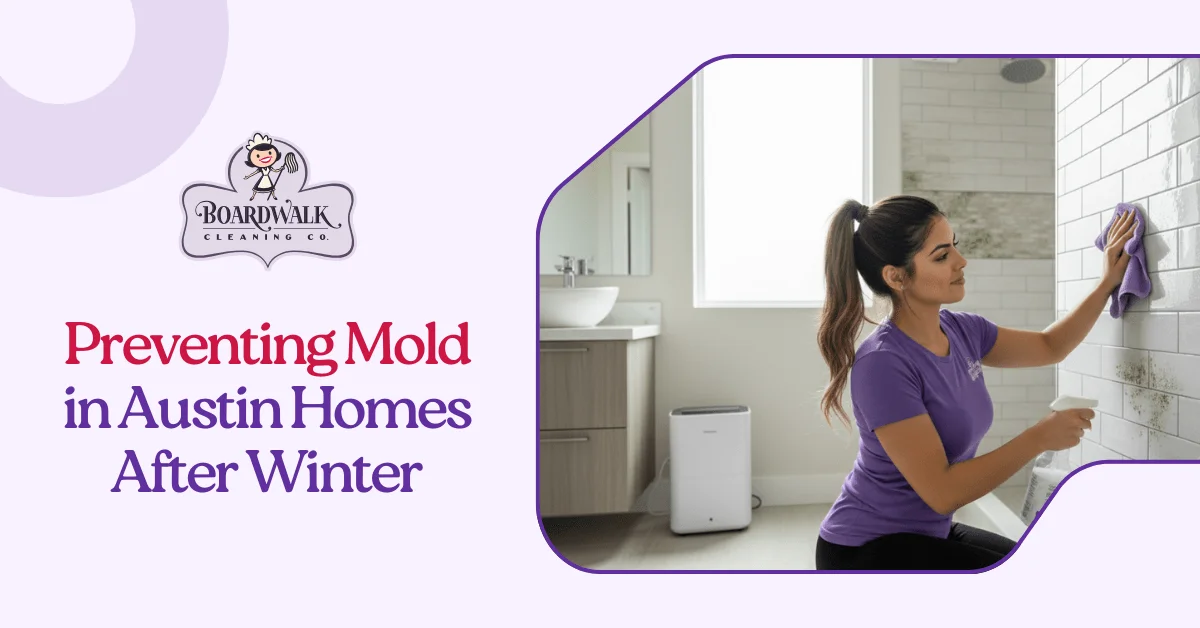
Introduction: Why Post-Winter Mold Is a Big Deal in Austin
When Austin finally starts to warm up after winter, most homeowners open the windows, turn down the heat, and get ready for spring. But that warm, damp air rolling in can wake up something you don’t want: hidden mold.
If you’ve noticed musty smells, dark spots in the bathroom, or condensation on windows as the seasons change, you’re not alone. In a humid city like Austin—with cedar fever, older HVAC systems, and bathrooms that stay damp—it’s easy for mold to sneak in after winter.
This guide walks you step-by-step through how to prevent mold in Austin homes after winter, from bathroom grout and windowsills to HVAC filters and laundry rooms. It combines practical homeowner tips with insights from a local cleaning company that’s been helping Austin families keep their homes healthy and comfortable for over 22 years.
Why Mold Prevention Matters in Austin (After Winter Especially)
Austin’s climate creates a perfect storm for mold, especially as we move from cooler, drier winter air into warmer, more humid spring weather.
Key local factors:
- Humidity and spring storms – As temperatures rise and moisture increases, damp areas (bathrooms, laundry rooms, around windows) stay wet longer.
- Cedar fever and allergens – Dust and pollen from cedar and oak can settle on damp surfaces, giving mold even more to feed on.
- Dust from rapid construction – In fast-growing areas like Pflugerville, Round Rock, and Leander, construction dust collects on vents, baseboards, and window tracks—all places mold can latch onto if they get damp.
- Common Austin home layouts – Ranch homes, older bungalows in central Austin, and two-story suburban homes often have tight bathrooms or low-ventilation areas where moisture lingers.
Preventing mold after winter isn’t just about looks. Mold can trigger allergies and breathing issues, especially for families already sensitive to cedar fever or indoor dust. A little prevention now can save you from bigger problems—and bigger bills—later.
Helpful resource: For a deeper look at health impacts and general mold guidance, the CDC offers clear information about mold in homes.
Early in your spring planning, it’s smart to review an Austin allergy cleaning guide for a full picture of how mold, dust, and pollen fit together in your home’s air quality:
- Internal link (Pillar): Learn more in our Austin allergy cleaning guide.
Where Mold Hides After Winter in Austin Homes
Before you can prevent mold, it helps to know its favorite hiding spots. In Austin homes, we most often see post-winter mold in:
- Bathrooms
- Shower grout and caulk
- Around tubs and under bath mats
- On ceilings above the shower
- Kitchens
- Under sinks and around plumbing leaks
- Around windows that collect condensation
- On caulk behind sinks
- Laundry rooms
- Around washer gaskets and detergent drawers (especially front-loaders)
- On walls behind appliances
- Windows and doors
- Window tracks and sills where condensation collects
- Sliding door tracks
- HVAC and vents
- Dusty return vents and around registers
- Near poorly insulated ducts where condensation forms
Most of these areas combine moisture + dust + poor airflow—the exact recipe mold loves.
For a deeper dive into moisture and humidity, it’s useful to explore Austin humidity and mold prevention tips, which expand on how local weather patterns affect your home:
- Internal link (Cluster): Check out these Austin humidity and mold prevention tips.
Step-by-Step: How to Prevent Mold in Austin Homes After Winter
This simple process will help you prevent mold as Austin moves from winter into spring.
Step 1: Do a Quick Post-Winter Mold Check
Set aside 30–45 minutes to walk your home and look for:
- Visible spots or patches – Dark spots on grout, walls, or around windows.
- Musty smells – Especially in closets, bathrooms, and laundry rooms.
- Condensation – Water beading on windows or walls.
- Peeling paint or bubbling drywall – Signs of hidden moisture.
Make a list of areas that need special attention.
Step 2: Improve Ventilation in Key Areas
Good airflow is one of the easiest ways to prevent mold in Austin homes after winter. Focus on:
- Bathrooms
- Run the exhaust fan during showers and for 20–30 minutes afterward.
- If your bathroom doesn’t have a fan, crack a window when weather allows.
- Laundry room
- Keep the door open when doing laundry to let steam escape.
- Make sure the dryer vent is properly connected and not clogged.
- Whole home
- Open windows on low-pollen days to create cross-breezes.
- Use ceiling fans to keep air moving in main living areas.
If your home feels stuffy even with fans running, that’s a sign you may need deeper help with dusting, vent cleaning, and recurring maintenance.
Step 3: Control Humidity (Especially in Spring and Early Summer)
In Austin, indoor relative humidity ideally stays between 30–50%. Higher than that, and mold growth becomes more likely.
Simple ways to control humidity:
- Use bathroom exhaust fans consistently during and after showers.
- Fix leaks promptly – even small drips under sinks can support mold.
- Consider a dehumidifier in damp rooms (bathrooms without windows, basements, or ground-floor rooms that feel clammy).
- Use your HVAC system wisely – running the AC during humid days helps pull moisture from the air.
Authoritative sources like the CDC and similar organizations recommend controlling moisture as the number one way to prevent mold in homes.
Step 4: Deep-Clean High-Risk Areas (Bathrooms, Kitchens, Laundry)
Plan a focused deep clean for the rooms that see the most moisture.
Bathrooms (30–60 minutes per bathroom)
- Scrub shower walls, grout, and caulk with a bathroom-safe cleaner.
- Wipe down ceilings above the shower where steam collects.
- Wash or replace shower curtains and liners.
- Lift bath mats and thoroughly dry the floor underneath.
- Check around the toilet base and under the tank for any moisture or staining.
Kitchens (45–60 minutes)
- Empty under-sink cabinets and check for leaks or damp wood.
- Clean around sink caulk and backsplash where water splashes.
- Wipe window tracks and sills near sinks or cooking areas.
- Clean and dry trash and recycling bins regularly.
Laundry Room (30–45 minutes)
- For front-load washers, clean the rubber door gasket and detergent drawer.
- Check the wall and floor behind the washer for signs of leaks.
- Make sure the dryer vent is securely attached and not damaged.
For homeowners who prefer checklists, it can help to print a one-page “post-winter mold prevention list” and tape it inside a utility closet to repeat each year.
Step 5: Stay on Top of HVAC & Filter Maintenance
Your HVAC system plays a big role in both air quality and mold prevention. In Austin, where we run AC a lot of the year, filters clog quickly with dust and cedar pollen.
Best practices:
- Change HVAC filters every 1–3 months, or more often if you have pets or allergies.
- Choose filters rated to capture small particles like pollen and mold spores.
- Keep air vents dust-free so airflow isn’t blocked.
- Have your system inspected on schedule if you notice musty smells when the unit kicks on.
Step 6: Use Safe Cleaning Habits (What
Not
to Do)
To keep mold away safely:
- Do not mix cleaners like bleach and ammonia—this can create dangerous fumes.
- Avoid relying only on “cover-up” sprays or heavy fragrance; they hide odors but don’t fix the source.
- Test any new cleaner on a small, hidden area first—especially in older Austin homes with delicate tile or stone.
- Always ventilate the area when using stronger cleaning products.
For emergency guidance on home safety after water damage or heavy moisture, organizations like the American Red Cross provide practical home mold prevention tips that are easy to follow.
Common Mold Myths Austin Homeowners Still Hear
Even experienced homeowners hear mixed advice about mold. Here are a few myths we see often.
Myth 1: “If I don’t see mold, I don’t have a problem.”
Reality: Musty smells, condensation, and peeling paint can mean moisture issues even before mold appears.
Myth 2: “Bleach fixes every mold issue.”
Reality: On some porous surfaces, bleach may not fully penetrate. Good prevention focuses on moisture control, not just spot treatment.
Myth 3: “Mold only grows in old, drafty homes.”
Reality: New builds in fast-growing Austin suburbs can have mold too—especially if ventilation isn’t great or construction dust wasn’t fully cleaned.
Myth 4: “Once I treat it, mold will never come back.”
Reality: If the underlying moisture problem isn’t fixed, mold can return quickly.
Professional Insight: What We See in Austin Homes After Winter
After serving thousands of homes in Austin over more than two decades, a few patterns show up every year as winter ends:
- Bathrooms with no fan or weak fans almost always show some mildew on grout or ceilings by spring.
- Homes near greenbelts or creeks (common in West Lake Hills, Lakeway, and parts of South Austin) tend to have higher humidity, especially on ground floors.
- Busy households—kids, pets, sports gear—often have “hot spots” for mold around entryways and laundry rooms where damp items get dropped and forgotten.
- Hard water + humidity leads to buildup in showers and around faucets; that buildup holds moisture and gives mold a place to cling.
Technicians who clean Austin homes regularly focus on:
- Drying shower areas thoroughly
- Wiping window tracks and sills
- Dusting vents and return grilles
- Checking under sinks for leaks during deep cleans
This kind of consistent attention is often what separates homes that stay mold-free from those that have recurring issues.
When DIY Isn’t Enough (And How Standard Cleaning Helps)
You can prevent a lot of mold on your own with good habits, ventilation, and seasonal deep cleans. But there are times when professional help is the safer, easier choice:
Consider calling in a team when:
- You’re seeing mold patches in multiple rooms.
- You or a family member has strong allergies or asthma.
- You’re too busy to keep up with routine dusting, vacuuming, and bathroom scrubbing.
- You’ve cleaned the same area several times and the mold keeps coming back.
A reliable standard house cleaning service in Austin can help by:
- Keeping bathrooms, kitchens, and high-moisture areas cleaned on a schedule.
- Catching problem areas early, before they turn into bigger mold issues.
- Reducing dust, dander, and allergens that can combine with moisture.
If you’re ready to hand off the routine cleaning so you can focus on your family, work, and free time, explore our standard house cleaning services in Austin to see how ongoing help fits your home and budget:
- Internal link (Conversion): Learn about standard house cleaning services in Austin.
Conclusion: A Simple Plan to Keep Mold Away After Winter
To sum it up, preventing mold in Austin homes after winter comes down to a few clear habits:
- Check high-risk areas (bathrooms, windows, laundry, under sinks) as the seasons change.
- Improve airflow with fans, open doors, and smart use of windows.
- Control humidity with exhaust fans, dehumidifiers, and prompt leak repairs.
- Deep-clean moisture-heavy rooms on a regular schedule.
- Get recurring help if your schedule or health makes upkeep hard to manage.
You don’t have to overhaul your whole home at once. Start with one bathroom and one problem area, then build from there. And when you’re ready to stop worrying about the routine cleaning and focus on enjoying your home, a trusted Austin team can make that shift easy and stress-free.
FAQ
Q1: How can I tell if mold after winter is serious enough to worry about?
If you see small, surface-level spots in one bathroom or around a window, you can usually handle it with good cleaning and better ventilation. If mold covers a large area, shows up in multiple rooms, or comes with strong musty odors, headaches, or breathing issues, it’s wise to consult a professional and possibly a remediation specialist.
Q2: How often should I deep-clean to prevent mold in Austin?
A good rule of thumb is to do a focused deep clean of bathrooms, kitchens, and laundry areas at least every 3–4 months, with an extra pass as winter ends and humidity rises. Regular weekly or bi-weekly maintenance cleanings help prevent moisture and dust from building up between deep cleans.
Q3: What’s the best cleaner to use on bathroom mold?
Most homeowners can use a bathroom-safe cleaner designed for mildew and soap scum. Always follow the label, test a small area first, and keep the space ventilated. Avoid mixing products, especially anything containing bleach with other cleaners. If you’re unsure about a surface (like natural stone), consider asking a professional before using harsh products.
Q4: Can a standard house cleaning service help with mold prevention, or do I need a special service?
A standard house cleaning service in Austin typically includes dusting, bathroom and kitchen cleaning, and regular wipe-downs of high-moisture areas—all of which support mold prevention. For existing, widespread mold problems, you may need a specialized remediation company first. After that, recurring cleaning helps keep things under control.
Q5: Is mold more common in certain Austin neighborhoods or home types?
We tend to see more moisture issues in homes near creeks, greenbelts, and areas with lots of trees, as well as in older homes with small, windowless bathrooms. That said, any home in Austin can develop mold if humidity is high and airflow is poor—whether it’s a downtown condo, a Round Rock family home, or a lake-area property. The key is consistent ventilation and cleaning.